DPMO Meaning In Text: Alternatives And Hiatus Meaning
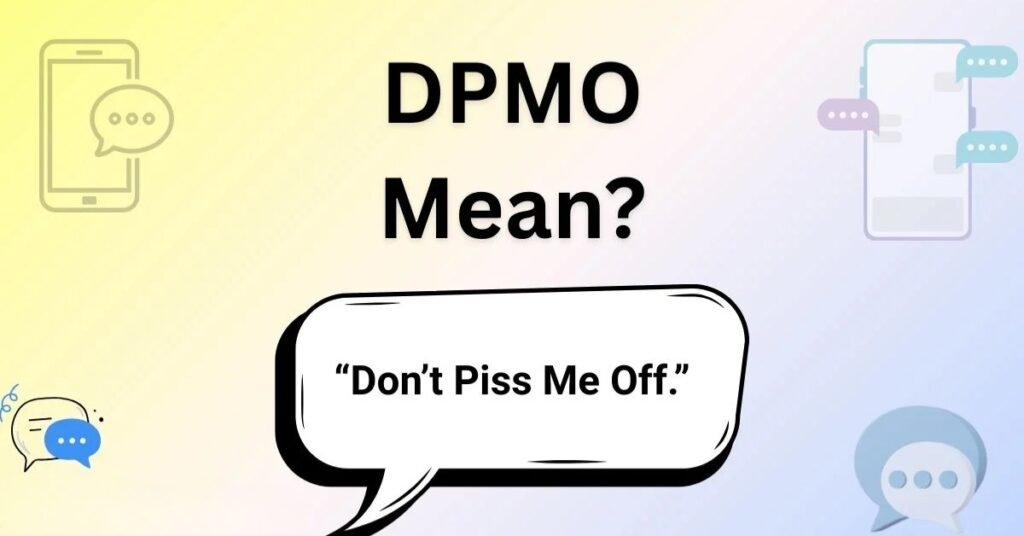
DPMO is a well liked slang elision that stands for “Don’t Piss Me Off.” Regularly used in text communications and online chats, it serves as a succinct way to convey frustration or exasperation. You may have experienced DPMO meaning in text in social media posts or digital correlation, where it is used to rapidly grab awareness during moments of tension or infuriation.
Because it is minuscule and direct, it is essentially suited for friendly conversation. Beyond meagre frustration, the term can also indicate that someone has outstretched their emotional curb or is setting up personal borderlines. Acquaintance with this diminutive will improve your comprehension of unceremonious digital transmissions and help you respond suitably to the tone of a conversation.
DPMO Meaning In Text And Its Definition
The short hand DPMO stands for “Don’t Piss Me Off.” This straightforward, direct phrase functions as a deterrent against cutting across boundaries or arousing someone’s disposition. In casual digital interchanges, it is customarily employed during vehemented, sarcastic, or argumentative exchanges.
If a fellow worker is consistently late and providing excuses, dispatching a message such as, “You said you’d be here thirty minutes ago; DPMO,” clearly liaises one’s annoyance. Despite its plainness, the term carries substantial emotional heaviness.
Using it incorrectly can signal hostility or disrespect, making it indispensable to fathom the shades of its application. While generally discerned as a sharp admonition, the elucidation of DPMO meaning in text depends laboriously on the relationship between the parties, the accepted tone, and the context of the discussions. In particular social circles, it may even be used jokingly among friends to friskily express lenient irritation.
The Hiatus Meaning Of DPMO
Beyond its verbatim definition, the term DPMO carries a cavernous emotional weight. While a superficial elucidation may seem direct or antagonistic, the utterance often communicates fundamental feelings of stress, debilitation, or susceptibility.
In digital communication, the inner intent behind DPMO habitually signals boundaries, transporting messages such as I have reached my limit, Please do not add to my stress, or Respect my personal space.
When utilized in texting, DPMO is used as more than a pronouncement of irritation; it is used as a clear measure of a sender’s emotional edge. By acknowledging this depth, recipients can better fathom that the sender is feeling coerced or swamped.
A message stating, “DPMO, I cannot handle any more tasks today”, goes beyond simple anger to provide a truthful mirroring of the sender’s state. Discerning this modulation is crucial for journeying digital conversations with affinity, as using the term without realization of its emotional context can inadvertently escalate conflict or create unnecessary tension.
Suitable Alternatives For DPMO Meaning Text
When you are required to communicate frustration or set boundaries without resonating hostile, there are a great many professional substitutions to belligerent acronyms that suit a variety of contexts. Selecting the right articulation allows you to preserve self control, de-escalate conflict, and communicate your needs effectively.
1. “Please don’t test my patience.”
This is a polite and professional way to state your boundaries clearly without being offensive. Example: “I have explained this several times; please don’t test my patience.”
2. “I’m trying to stay calm here.”
This casual yet transparent phrase signals that you are feeling stressed while avoiding direct aggression. Example: “I’m trying to stay calm here, but this situation is becoming quite frustrating.”
3. “Let’s not go there.”
This controlled, assertive statement is ideal for preventing a conversation from escalating further. Example: “I understand your perspective, but let’s not go there right now.”
4. “Don’t push it.”
Concise and firm, this phrase is socially acceptable in most casual settings. Example: “You’ve mentioned that three times already; please don’t push it.”
5. “That’s not helping.”
Professional and neutral, this phrase conveys disappointment rather than anger. Example: “Bringing this up at the moment is not helping our progress.”
6. “Let’s stay respectful, please.”
This is an excellent choice for team chats, forums, or professional correspondence. Example: “We are trying to move forward; let’s stay respectful, please.”
7. “I’ve reached my limit for today.”
This emotionally honest and gentle approach communicates that you are overwhelmed without expressing hostility. Example: “I’ve reached my limit for today; let’s continue this conversation tomorrow.”
8. “I don’t have the energy for this right now.”
This honest and vulnerable statement allows you to express emotional fatigue effectively. Example: “I understand your point, but I honestly don’t have the energy for this right now.”
9. “Not the time, not the place.”
Assertive and situational, this phrase is highly effective at preventing inappropriate or poorly timed arguments. Example: “You want to debate this now? This is neither the time nor the place.”
10. “I’d rather not get into this.”
Polite and diplomatic, this is a perfect way to decline a sensitive or unproductive discussion. Example: “Honestly, I’d rather not get into this right now.”
11. “Let’s not make this worse.”
Cautionary and compassionate, this phrase discourages further escalation by focusing on a mutual goal. Example: “We are both tired; let’s not make this situation worse.”
These alternatives exemplify how to express frustration in written communication while remaining composed, respectful, and effective.
When To Avoid The Use Of DPMO Meaning In Text?
Although using the acronym DPMO in social media or casual conversation may be convenient, there are several contexts where it should be avoided. You should refrain from using it in professional emails, workplace messaging, or during interactions with authority figures. It is also unsuitable for sensitive discussions or situations requiring a diplomatic approach.
Employing this abbreviation in formal scenarios can make you appear unprofessional, emotionally reactive, or disrespectful. Sending DPMO meaning in text to a manager or colleague may be interpreted as a lack of patience or an unwillingness to cooperate. In such cases, it is better to use polite language or professional alternatives that communicate your boundaries without conveying aggression.
Understanding appropriate communication boundaries ensures that you maintain respect and clarity while still expressing your feelings. Being mindful of your audience and the context is essential to avoiding miscommunication and preventing unnecessary conflict.
Difference Between Casi Algo Meaning And DPMO Meaning In Text
- What precisely is a “Casi Algo”? While the term interprets literally to “almost something,” its true meaning is far more modulated, describing a relationship or situation that feels enormously substantial yet remains aggravatingly undefined.
- The short hand DPMO stands for “Don’t Piss Me Off.” This straightforward, direct phrase functions as a deterrent against cutting across boundaries or arousing someone’s disposition.
Conclusion
The acronym DPMO conveys far more than its literal translation, “Don’t Piss Me Off.” Beyond the surface-level frustration, the term often signals deeper issues such as chronic stress, emotional fatigue, and a critical need for personal boundaries.
Understanding when to use DPMO meaning in text in digital communication—and when to opt for more constructive alternatives—is essential for maintaining effective, respectful, and emotionally intelligent interactions.
Before sending a message as blunt as DPMO, take a moment to pause and evaluate the context. Choosing words that accurately reflect your state of mind allows you to express yourself clearly while protecting your well-being and preserving the health of your personal and professional relationships. In the landscape of modern text slang, emotional awareness is the ultimate key to mastering your conversations.
FAQs
What Does DPMO Mean in Text?
The short hand DPMO stands for “Don’t Piss Me Off.” This straightforward, direct phrase functions as a deterrent against cutting across boundaries or arousing someone’s disposition.