

Comming Or Coming: Understanding The English Grammar
The spelling of comming or coming is a recurrent point of uncertainty for many English apprentices. The accurate form of the verb come, when amended with the suffix -ing, is at all times coming; the spelling comming is scrutinized to be incorrect and should be evaded in ceremonious writing.
Although this materializes to be a slight error, learning proper spelling is necessary for preserving a professional and shiny writing manner. The word coming sticks to conventional English protocols by tumbling the silent e before incorporating the -ing suffix. Fathoming and appertaining this rule will help you constantly avoid one of the most customary mistakes in English logography.
Understanding The Difference Between Comming Or Coming
At first glimpse, comming and coming may come into view as similar, but only one is grammatically acceptable. The bona fide spelling is coming; comming is a fallacy. Coming is the present participle of the verb come, which marks moving toward or approaching, as in the sentence, “He is coming to the meeting today”.
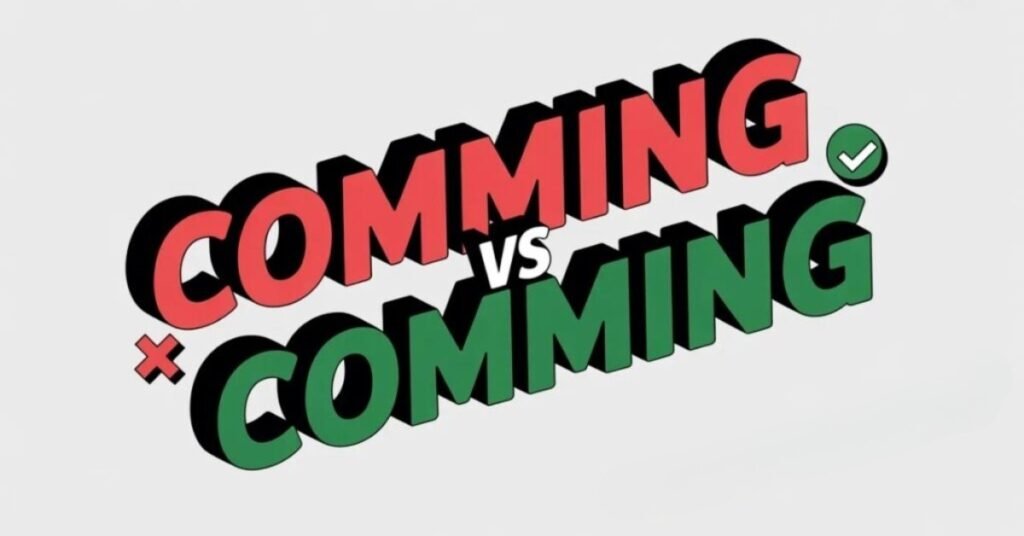
The spelling comming is mistaken and does not cling to the typical rules for verb assemblage in American English. This scepticism often comes from extrapolating the innumerable rules for adding-ing to verbs. Knowing inside out why coming is the correct form will help you avoid similar spelling mistakes in your writing.
Why Comming Is Incorrect?
Novices often scuffle with this inaccuracy because they mishandle the rules concerning silent “e” and consonant doubling. When adding the suffix “-ing” to verbs, English follows congruous patterns that command whether to duplex a consonant or leave out a silent “e.”
Because the verb “come” does not meet the standard for doubling a consonant, it sticks to the silent “e” rule instead; you must drop the “e” before adding “-ing,” ensuing in the correct form, “coming.“
The Consonant Doubling Rule To Explain Coming Vs Comming
The consonant doubling rule is a foundational principle of English precise spelling, specifically when appending suffixes such as -ing. To solicit this rule accurately, a verb must satisfy three specific criteria: the word must end in a single consonant, the preceding vowel must have a short sound, and the final syllable must be stressed.
The verb run becomes running because it meets all three conditions: it ends in a single consonant, features a short vowel sound, and consists of a single stressed syllable. This logic also applies to words like sit and stop, which become sitting and stopping. A word like come does not qualify because it ends in a silent e rather than a single consonant; therefore, doubling the m would be incorrect.
| Base Word | With -ing | Reason |
| Run | Running | Short vowel, single consonant |
| Sit | Sitting | Short vowel, single consonant |
| Stop | Stopping | Short vowel, single consonant |
These examples illustrate how the rule maintains consistent vowel pronunciation when a suffix is attached. Conversely, the following words do not require doubling because they fail to meet the necessary criteria:
| Base Word | With -ing | Reason |
| Happen | Happening | Stress on first syllable |
| Meet | Meeting | Long vowel sound |
| Listen | Listening | Ends in two consonants |
| Come | Coming | Ends in silent e |
As shown, the transition from come to coming adheres to a different convention: the silent e rule. By understanding these distinct criteria, you can accurately determine when to double a final consonant and when to follow alternative spelling patterns.
The Silent E Rule To Explain Coming Or Comming
The silent e rule is a rudimentary aspect of English orthography and verb conjugation. When appending a suffix that begins with a vowel, such as -ing, -ed, or -er, the silent e at the end of the base word is omitted. This adjustment ensures that words remain both phonetically logical and grammatically accurate.
Base words like make, love, and come transition to making, loving, and coming. Attempting to spell words like coming as comming incorrectly preserves the silent e and introduces an extra consonant, violating standard English spelling conventions. Examples of the Silent E Rule:
| Base Word | Transformed Word |
| Love | Loving |
| Bake | Baking |
| Move | Moving |
| Come | Coming |
Sticking to this rule is indispensable for maintaining precision, clarity, and professionalism in all forms of written communication.
Examples Of Use Of Coming In Different Contexts
The word coming is adaptable, appearing in contexts ranging from professional correspondence to casual conversation. Mastering the modulations of this term within numerous settings will cement your comprehension of verb forms and increase your overall writing efficiency.
- In a Business Email
Thank you for coming to today’s meeting. Your contributions were invaluable.
- In a Motivational Speech
You are coming closer to your goals every day. Keep moving forward.
- In Casual Conversation
Are you coming to the movie tonight? It should be a great time.
- In Literature
The storm was coming fast, casting a dark shadow across the entire sky.
These examples illustrate how naturally the word coming adapts to different tones and contexts, serving as an effective tool for improving your English writing.
Difference Between ATP Meaning In Text And Comming Or Coming
- Frequently used in texting and social media, the elision ATP stands for “At This Point” and presents as a condensed way to indicate that someone has got to their limit, terminated caring, or directly feels done with a discrete situation.
- At first glimpse, comming and coming may come into view as similar, but only one is grammatically acceptable. The bona fide spelling is coming; comming is a fallacy. The core difference between both is that one is a slang used in informal digital communication and comming or coming is a grammatical question.
Conclusion
Distinguishing between comming or coming requires more than simple memorization; it involves understanding the fundamental principles of English word formation. The correct spelling, coming, adheres to the silent-e rule rather than the consonant-doubling rule.
Mastering these orthographic conventions and applying them consistently will not only eliminate common errors but also elevate the clarity and professionalism of your writing. By cultivating a habit of diligent proofreading, utilizing reliable spelling correction tools, and remaining mindful of grammatical best practices, you will refine your writing skills and communicate with greater confidence and precision.
FAQs
Is It Comming Or Coming?
At first glimpse, comming and coming may come into view as similar, but only one is grammatically acceptable. The bona fide spelling is coming; comming is a fallacy.